Mastering Sound: The Comprehensive Guide to Yamaha’s DM Series Digital Consoles
For professional audio engineers, the constant pursuit comes down to three core pillars: uncompromising sonic transparency, streamlined workflow efficiency, and scalable adaptability. For decades, professionals have relied on major brands to address these everyday hurdles.
Yamaha, however, takes a different approach. By collaborating closely with people across the industry, they create solutions where others have fallen short, setting a clear benchmark for live sound and broadcast reinforcement, tracing all the way back to the historic launch of their first digital mixer, the DMP7, in 1987.
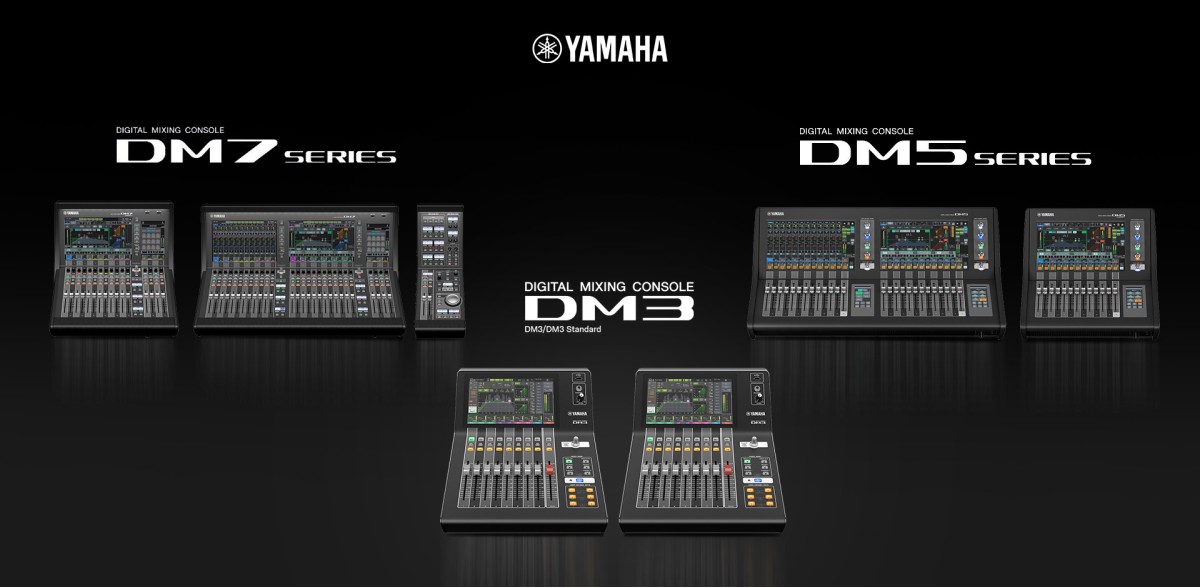
With the introduction of the modern DM Series, Yamaha has completely redefined what engineers can expect from a contemporary mixing ecosystem. Spanning ultra-compact production tools, mid-sized regional workhorses, and massive arena-ready touring flagships, the DM family provides a unified platform for every tier of audio production.
Product Lineup Overview
In early 2023, Yamaha officially established the DM Series foundation by rolling out the DM3 Series, bringing high-resolution 96kHz processing to an ultra-compact form factor. This was soon followed by the flagship DM7 Series to cater to large-scale professional tours and broadcast environments.
Yamaha further expanded the ecosystem by introducing the DM5 Series, which bridges the gap between the DM3 and DM7 families, alongside the DM7 Series V2 firmware update and RUio Series utility I/O devices.
Model Breakdown
The DM3 Series
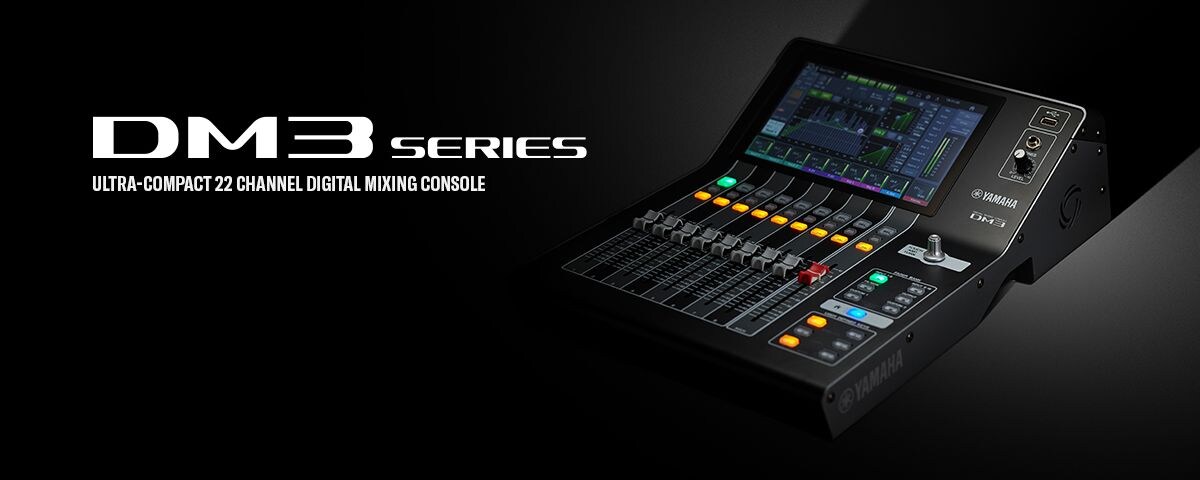
The Yamaha DM3 Series brings high-resolution 96kHz processing and professional capabilities into an ultra-compact footprint. The lineup is split into two primary models depending on your networking requirements:
- DM3-D: This version comes equipped with built-in Dante audio-over-IP networking featuring 16x16 Dante I/O, making it ideal for modern networked setups. It features 16 local mic and line inputs (12 XLR ports and 4 combo jacks), 8 physical XLR outputs, and an 18x18 USB audio interface capability for seamless multitrack recording and playback.
- DM3 Standard (DM3S): This version retains the exact same core audio processing, physical layout, and 9-inch multi-touch display as the Dante model. However, it omits Dante networking, making it a streamlined choice for traditional analog setups and USB-centric workflows.
The DM5 Series (Mid-Size Powerhouse)
.jpg)
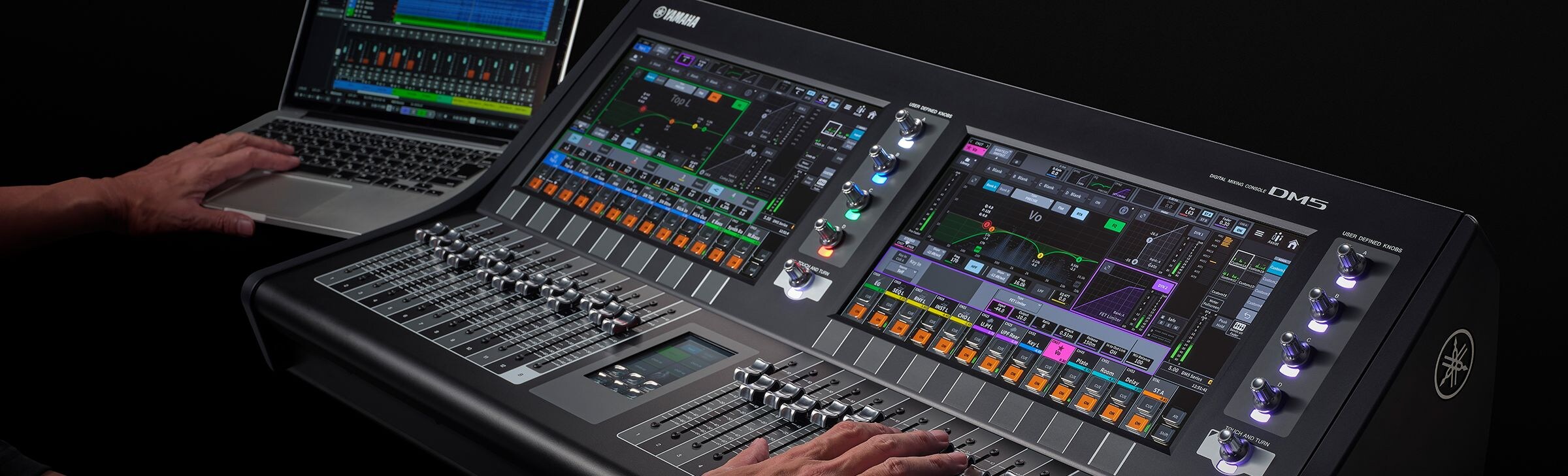
Positioned as the bridge between the ultra-compact DM3 and the flagship DM7 families, the DM5 Series brings advanced professional mixing capabilities, high-resolution audio processing, and flexible control layouts into a versatile mid-size format.
- DM5 Compact: Designed for streamlined spaces and fast-paced environments, featuring 48 mixing channels, 13 physical faders, 16 analog inputs, 16 analog outputs, 64x64 Dante networking, and an 18x18 USB audio interface.
- DM5 (Full): Expands capacity to 60 mixing channels, 26 physical faders, and 32 analog inputs alongside 16 analog outputs. It is built around a dual-bay multi-touch screen layout comprising dual 13.3-inch main displays and dual 4.3-inch utility displays paired with 64x64 Dante architecture. Both models integrate advanced Glass-Key touchscreens, tiltable interfaces, and PY-card expansion slots for added processing resources such as Premium Rack plugins.
The DM7 Series (Professional Touring & Broadcast Flagships)
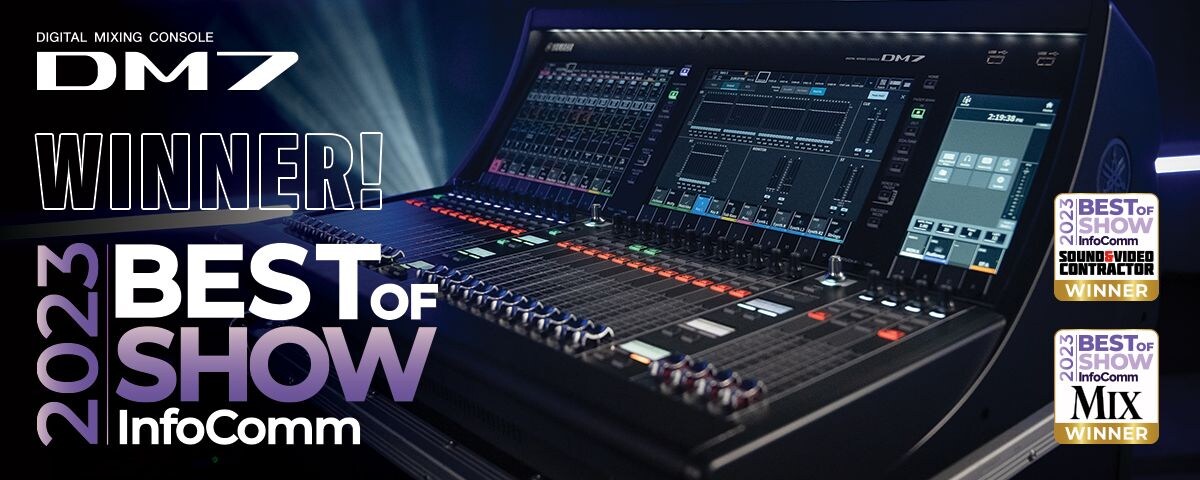
Built to meet the rigorous demands of large-scale live sound tours, broadcast setups, and theater productions, the flagship DM7 Series delivers massive mixing capacity, advanced redundancy, and flexible control layouts.
Building on its immediate industry-wide acclaim, including multiple Best of Show accolades upon release, the series later earned major recognition as an official NAMM TEC Award nominee for outstanding technical achievement in sound reinforcement.
- DM7 Compact: A streamlined footprint featuring 72 mono input channels, 16 motorized faders (12+4), and a dual-screen display architecture combining a 12.1-inch main touchscreen with a 7-inch utility screen.
- DM7 (Full): The flagship console scaling up to 120 mono input channels, 28 motorized faders (24+4), and a massive dual-touchscreen workspace designed for complex multi-operator mixing environments. Both models include built-in dual redundant power supplies and 144x144 Dante networking.
- DM7 Control: An optional hardware expansion unit that attaches directly to the console, adding user-defined physical knobs, a dedicated jog wheel, and extra faders and switches for tactile hands-on control.
Core Features & Technological Innovations
The DM Series is more than just a collection of different sizes. It represents a major generational leap in digital signal processing, user interface design, and system integration.
High-Resolution 96kHz Audio Processing
Unlike many entry-level and mid-tier digital consoles that compromise sample rates to preserve processing headroom, the DM Series supports pristine 96kHz audio processing across the entire lineup, including the compact DM3. This high sample rate ensures ultra-low latency, crystal-clear transient response, and a level of spatial depth that satisfies the most demanding acoustic standards.
RIVAGE-Derived Vintage Emulation & Dynamics
Inheriting advanced algorithms from Yamaha's flagship RIVAGE PM series, the DM7 and DM5 ranges feature legendary analog-modeled processors. Engineers have direct access to acclaimed dynamics and EQ emulations, including FET limiters and Diode Bridge compressors.
Touch-Driven Workflows & Glass-Key Architecture
Modern sound engineers expect the responsiveness of smart devices combined with the tactile precision of physical faders. The DM Series incorporates responsive multi-touch screens paired with physical encoders. On the DM7 and DM5 models, the Advanced Glass-Key Touchscreen design minimizes menu diving, placing critical parameters like sends, dynamics graphs, and routing matrices right at the engineer's fingertips.
Advanced Automation: Dan Dugan Speech System
For corporate events, theatrical productions, and houses of worship, managing multi-microphone setups manually can introduce phase anomalies and background noise buildup. The DM Series integrates the industry-standard Dan Dugan Speech System automixer across its channel strips. This intelligent algorithm automatically manages microphone gains in real time, ensuring speech clarity remains razor sharp without manual fader riding.
Ecosystem Expandability & Software Packages
- PY Series Card Slots: The DM5 and DM7 Series feature rear-panel PY card slots, allowing users to expand system connectivity with modular cards like the PY-DSP, PY64-D, PY64-MD, PY8-AE, and PY-MIDI-GPI.
- Specialized Software Licenses: Optional software add-ons cater to specific vertical markets. The Broadcast Package introduces specialized features like Mix Minus and advanced loudness meters, while the Theatre Package provides actor library management and immersive spatial cue controls.
Use Cases
Because the DM Series scales cleanly across form factors, different industries and production teams leverage specific models for unique operational challenges.
1. Houses of Worship & Multi-Campus Sanctuaries
Houses of worship require equipment that bridges high-end acoustic capability with operational accessibility for rotating volunteer teams.
- Sanctuaries: Medium-to-large churches deploy the DM5 or DM7 Compact connected via lightweight Ethernet cable runs to Dante stageboxes such as Rio Series units. The Dan Dugan automixer effortlessly manages complex multi-mic choir and pulpit setups.
- Youth Rooms & Portable Satellites: Smaller breakout rooms utilize the DM3-D. By pairing the console with Yamaha ProVisionaire Touch software, audio directors can build custom, simplified control layouts for volunteers.
2. Live Streaming, Hybrid Studios & Content Creation
In modern broadcasting, video and audio must integrate seamlessly. The DM3 Series serves as both a powerful live mixing console and an 18x18 USB audio interface. Content creators and studio engineers can track at 96kHz directly into DAWs like Nuendo or Pro Tools while managing custom mix-minus feeds in real time.
3. Regional Touring & Corporate Production
Rental houses and regional production companies favor the DM5 and DM7 Compact consoles because they fit within tight truck-pack restrictions while handling massive input lists. Their robust virtual soundcheck capabilities allow engineers to dial in systems before performers even step foot on stage.
Real-World Case Studies & Industry Adoption
The true test of any professional audio lineup is how it performs under the grueling conditions of international touring and high-stakes live events.
Arena Power in a Club Footprint: Twenty One Pilots on Tour
When alternative and electro-pop acts like Twenty One Pilots scale down from massive stadium productions to intimate club shows, available space shrinks dramatically.
For Front of House engineer Kenny Sellers and monitor engineer Cliff Skinner, the challenge was fitting an expansive production with more than 70 inputs into severely restricted footprints, while maintaining the same professional standards expected from larger venues.
Frequently Asked Questions
1. What is the Main Difference Between the DM3 and DM3 Standard?
The primary difference is network integration. The DM3 includes built-in Dante audio-over-IP networking, while the DM3 Standard removes Dante entirely for analog and USB-focused workflows.
2. Can I Use My Existing Yamaha Stageboxes with the DM Series?
Yes. Any Dante-equipped console in the DM lineup integrates seamlessly with Yamaha Tio1608-D and Rio Series stageboxes using standard Ethernet cabling.
3. Do the Compact Models Sacrifice Audio Quality or Sample Rates?
No. Every console in the DM Series supports full 96kHz high-resolution audio processing.
4. What Software Packages Are Available?
Yamaha offers the Broadcast Package, Theatre Package, and expanded Dan Dugan Automixer licenses for specialized applications.
Choosing Your DM Solution
Choosing the right DM Series console depends entirely on your production demands, venue scale, and workflow requirements.
Opt for the DM3 Series for portable streaming, mobile tracking, and compact AV environments. Step up to the DM5 Series when you require increased channel counts and expansion flexibility. Choose the flagship DM7 Series when tackling large-scale touring, broadcast, and advanced production workflows.
If you want to experience these consoles hands-on, visit the Thomsun Learning & Experience Center (TLEC) in Al Quoz, Dubai.
For more information or to discuss your specific requirements, feel free to email info@thomsun.ae.
About the Author
Ranen is a Thomsun Music writer and multi-instrumentalist with over 20 years in the industry. Currently playing with the electro-pop/rock duo Radicchio, he holds DipLCM and ALCM diplomas in performance from the University of West London. He blends two decades of recording and stage experience to give gear reviews the technical depth they require.

